- Kamil
- Piling contractors London
- 0 Comments
If you notice diagonal cracks wider than 3mm, doors and windows jamming, or visible slope in floors — your foundations may be moving. In London’s clay soils, seasonal shrinkage and swelling is the most common cause. Minor cracking under 2mm is usually cosmetic. Anything wider, recurring or progressive needs a structural engineer’s assessment and potentially mini piling or underpinning to stabilise the building permanently.
Foundation failure is one of the most common structural problems in London properties — and one of the most misunderstood. Homeowners often ignore early warning signs until damage becomes severe and repair costs escalate. This guide explains what causes foundations to fail in London, how to identify the warning signs early, what a structural engineer will look for during assessment, and when piling becomes the only reliable solution.
What Causes Foundation Failure in London?
London sits on some of the most variable ground in the UK. Within a single borough you can find stiff London Clay, river terrace gravels, alluvium, made ground and Bagshot Sands — sometimes on the same street. This variability means foundations that worked for decades can start failing when conditions change.
1. Clay shrinkage and swelling — the biggest cause
London Clay expands when wet and shrinks when dry. During hot, dry summers the clay contracts and pulls away from shallow foundations, causing them to drop. During wet winters the clay swells back — but not always evenly. This seasonal cycle creates cumulative movement that eventually cracks walls, distorts door frames and damages internal finishes.
The problem is getting worse. UK summers are becoming hotter and drier, and the clay is drying to greater depths than it did 30 years ago. Properties built before the 1960s — when foundations were typically only 600–900mm deep — are most vulnerable because their foundations sit entirely within the zone of seasonal moisture change.
According to the British Geological Survey, London Clay has a “very high” shrink-swell potential across most of central and south London. This is the single biggest driver of subsidence claims in the UK.
2. Tree root damage
Mature trees extract enormous volumes of water from the soil. A single mature oak can remove over 40,000 litres per year. When a large tree grows close to a building on clay soil, the roots dry out the clay beneath the foundations — causing localised shrinkage and differential settlement.
The most problematic species in London are oak, willow, poplar, ash, plane and lime. As a general rule, if a tree is within a distance equal to its mature height from the building, it could be affecting the foundations. We covered this in detail in our guide to trees, clay soil and foundation movement in London.
3. Inadequate original foundations
Many London properties — particularly Victorian and Edwardian terraces — were built with shallow strip foundations of lime mortar and brick, often only 450–900mm deep. These foundations were adequate for the original structure, but they sit within the zone of seasonal moisture change and have no reinforcement.
When load is added (loft conversions, rear extensions, additional storeys) or when ground conditions change (nearby tree growth, drainage failure, climate change), these shallow foundations cannot cope and the building starts to move.
4. Drainage failure and water ingress
Leaking drains, broken downpipes and poor surface water management can saturate the ground beneath foundations. In granular soils this causes washout — soil particles are literally carried away by water flow, creating voids beneath the foundation. In clay soils, prolonged water ingress can soften the bearing stratum and reduce its load-carrying capacity.
A CCTV drain survey (typically £200–£400 in London) can identify cracked or collapsed drains that may be contributing to foundation movement. This is one of the first things a structural engineer will recommend.
5. Nearby construction and excavation
Basement excavations, deep trenches and piling works on neighbouring properties can affect the stability of adjacent foundations — particularly if the excavation removes lateral support from the soil beneath your building. This is why party wall agreements exist and why structural monitoring is often required during neighbouring construction works.
6. Made ground and historical infill
Parts of London — particularly Docklands, Battersea, Bermondsey, Stratford and areas along the Thames — were built on made ground: land that was artificially raised using rubble, waste, demolition debris or industrial spoil. Made ground is inherently unpredictable — it can contain voids, decomposing organic material, variable density and contamination. Foundations on made ground are prone to long-term settlement as the fill material continues to consolidate.
Warning Signs: How to Spot Foundation Problems Early
Not every crack in a London house means the foundations are failing. Hairline cracks under 1mm in plaster are almost always caused by thermal movement, drying shrinkage of new plaster, or minor settlement — and are cosmetic, not structural.
The warning signs that indicate genuine foundation movement are:
- ⚠Cracks wider than 2–3mm — particularly diagonal cracks running from the corners of windows or doors towards the ground at roughly 45 degrees. These indicate differential settlement.
- ⚠Cracks wider at the top than the bottom — this pattern suggests the foundation on one side has dropped, causing the wall above to rotate.
- ⚠Doors and windows that stick or jam — when foundations move, frames distort. If a door that previously opened freely now sticks at the top corner, the wall above it has moved.
- ⚠Visible gaps between walls and ceilings or floors — separation between structural elements indicates independent movement.
- ⚠Cracks that reappear after repair — if you fill a crack and it reopens within a few months, the movement is ongoing.
- ⚠Sloping floors — place a ball on the floor. If it rolls consistently in one direction, the floor is not level. A progressive slope indicates active foundation movement.
- ⚠External cracks in brickwork — stepped cracks following mortar joints on the outside of the building are a stronger indicator of structural movement than internal plaster cracks.
BRE Crack Classification
The Building Research Establishment (BRE) classifies structural cracks on a scale from Category 0 to Category 5:
| Category | Crack Width | Severity | Action Required |
|---|---|---|---|
| 0 | Up to 0.1mm | Negligible | None — hairline, cosmetic only |
| 1 | Up to 1mm | Very slight | Cosmetic repair only |
| 2 | Up to 5mm | Slight | Investigation if recurring or progressive |
| 3 | 5–15mm | Moderate | Professional structural assessment required |
| 4 | 15–25mm | Severe | Significant structural repair — piling or underpinning likely |
| 5 | Over 25mm | Very severe | Major structural repair — risk of partial instability |
What to Do If You Suspect Foundation Failure
If you notice Category 2+ cracks or multiple warning signs, follow this sequence:
Step 1: Monitor the cracks. Install crack monitors (under £10 each from builders’ merchants) across the widest cracks. Record readings monthly. This gives the structural engineer objective data on whether the movement is active, seasonal or historic.
Step 2: Commission a structural engineer’s report. A chartered structural engineer (look for CEng MIStructE after their name) will inspect the property, assess the crack pattern and recommend next steps. A typical residential structural survey in London costs £500–£1,500. The Institution of Structural Engineers has a searchable directory.
Step 3: Ground investigation. If the structural engineer suspects foundation movement, they will usually recommend a ground investigation — trial pits to expose existing foundations and boreholes to assess soil conditions. This typically costs £2,000–£5,000 in London.
Step 4: Remedial scheme design. Based on the investigation findings, the structural engineer designs the repair — specifying pile type, depth, diameter, spacing and connection details.
Step 5: Building control notification. Foundation remediation is notifiable work under UK Building Regulations (Approved Document A). Your contractor must notify local building control before starting. At KHB Piling we liaise directly with building control on every project. See our guide on building regulations for foundations in London.
When Is Piling the Right Solution?
| Situation | Recommended Action |
|---|---|
| Cosmetic cracks only (Cat 0–1), no ongoing movement | Fill, decorate, monitor. No structural intervention needed. |
| Seasonal movement in clay (Cat 2), stabilised after tree removal | Tree management + drainage improvement. Monitor 12 months. Piling may not be necessary. |
| Progressive movement (Cat 2–3), cause not removable | Mini piling or underpinning required. |
| Significant structural damage (Cat 3–5) | Piling or underpinning almost always required. Existing foundations have failed. |
| Adding load (loft conversion, extension, additional storey) | Piling for the extension required if existing foundations cannot support additional load. |
How Piling Fixes Foundation Failure
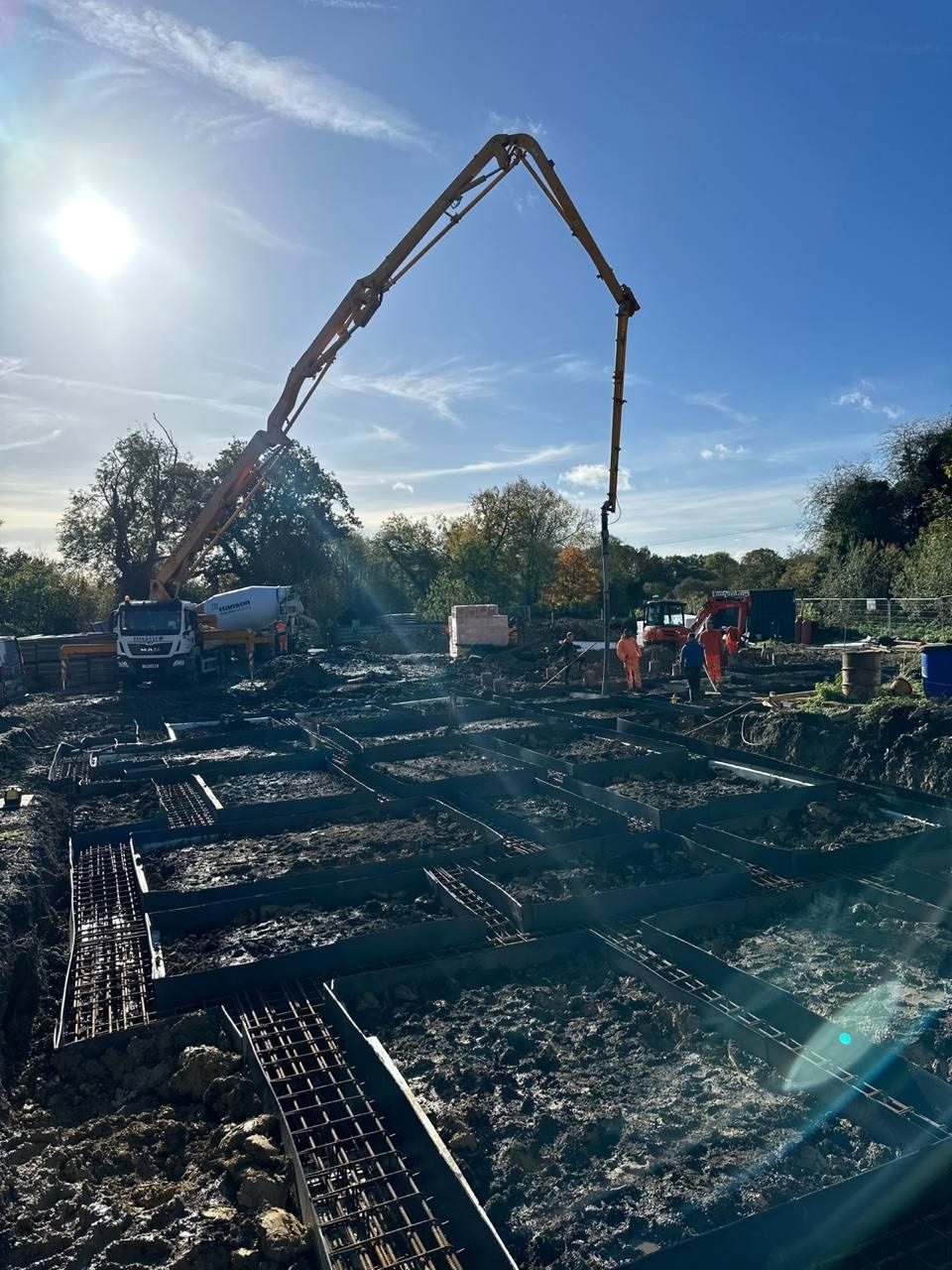
Piling works by transferring the building’s load from the failed shallow foundation to a deeper, stable bearing stratum — typically London Clay at 6–12 metres depth, below the zone of seasonal moisture change.
The process for remedial piling on an existing London property typically involves:
- 1Excavation alongside the existing foundation to expose the footing.
- 2Installation of mini piles at specified centres (typically 1.5–2.5m spacing) adjacent to the existing foundation.
- 3Construction of a reinforced concrete needle beam or pile cap connecting the new piles to the existing foundation.
- 4The building’s load transfers from the old foundation through the needle beam into the new piles and down to stable ground.
The entire process for a typical terraced house usually takes 2–4 weeks. Mini piling rigs are compact enough to work inside existing buildings, through doorways and in rear gardens with restricted access — which is why mini piling is the most common method for foundation remediation in London.
For a detailed cost breakdown, see our guide: How much does mini piling cost in London?
Insurance and Subsidence Claims
Most buildings insurance policies cover subsidence — defined as downward movement of the ground beneath the building. However, there are important caveats:
- →Insurers typically require 12 months of monitoring before approving a piling or underpinning claim. They want evidence that movement is progressive, not seasonal or historic.
- →Policies typically exclude damage caused by new construction, alterations or extensions — so if you added a loft conversion that overloaded the foundations, the insurer may not cover the remediation.
- →Excess on subsidence claims is usually £1,000 (much higher than standard policy excess).
- →A subsidence claim becomes a material fact that must be disclosed when selling the property. This can affect value and future insurability.
Tip: Some homeowners choose to fund remedial piling privately (£15,000–£40,000) rather than claim on insurance — particularly if the cost is manageable — to avoid the disclosure requirement and its impact on property value. Consult a loss assessor (who works for you, not the insurer) before deciding.
Prevention: Reducing the Risk of Foundation Failure
Prevention is always cheaper than cure. For London homeowners on clay soils:
- ✓Manage trees proactively. Crown-reduce or remove trees within their mature height distance of the building — especially oak, willow and poplar. Check for Tree Preservation Orders (TPOs) before any works.
- ✓Maintain drainage. Inspect and repair gutters, downpipes and underground drains regularly. A CCTV drain survey every 5–10 years is worthwhile on London Clay.
- ✓Monitor cracks. Install crack monitors on any crack wider than 1mm. Record readings seasonally. Early detection gives you more options and lower repair costs.
- ✓Survey before buying. If purchasing a Victorian or Edwardian property on London Clay, invest in a structural engineer’s report (£500–£1,500) before exchange. Far cheaper than discovering foundation failure after completion.
- ✓Check before extending. Commission a ground investigation before planning a home extension or loft conversion. Designing piling into the project from the start is far cheaper than retrofitting later.
Need a Foundation Assessment?
If you have noticed warning signs of foundation movement in your London property, contact KHB Piling for a free initial consultation. We can advise whether piling or underpinning is likely to be needed and provide a detailed quotation.
Frequently Asked Questions — Foundation Failure London

My name is Kamil, and I specialise in piling services in London. I am dedicated to advancing KHB Piling LTD, a trusted contractor delivering high-quality foundation solutions for both residential and commercial projects. With the expertise and commitment of our team, we provide reliable piling services, including mini piling and CFA piling, tailored to meet the unique requirements of each client.